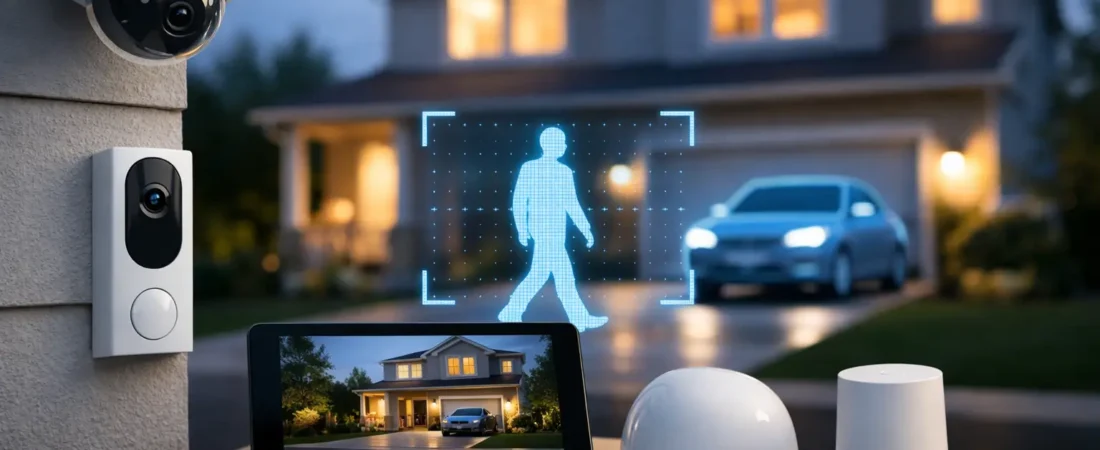
A phone alert at 2:13 am hits differently when you cannot tell whether it is a parcel left on the step, a fox in the garden or someone testing your back door. That uncertainty is exactly where an AI-powered home security system changes the experience of protecting your home. Instead of simply reacting to motion, it adds context, learns patterns and helps you respond faster with better information.
For homeowners who already use cameras, smart locks, lights or voice assistants, the appeal is not just more technology. It is having security that behaves like an intelligent layer across the home, rather than a collection of disconnected gadgets. Done well, AI does not make home security feel more complicated. It makes it more usable when something actually matters.
What an AI-powered home security system actually does
Traditional systems are built to detect events. A door opens. A sensor trips. Motion appears in frame. That still matters, but it leaves the homeowner to figure out what the alert means and whether it needs action.
An AI-powered home security system goes further. It analyses what is happening, filters out low-value triggers and prioritises events that look genuinely unusual or risky. That might mean recognising the difference between a person and a pet, spotting movement in a restricted area at an odd hour, or identifying behaviour that does not match the normal rhythm of the household.
The practical benefit is simple. You spend less time checking noise and more time seeing what deserves attention. That matters whether you are upstairs, at work or away for the weekend.
Why older alarm setups are starting to feel dated
Many legacy systems were designed around a loud siren and a fixed set of sensors. They can still provide a basic deterrent, but they often create the same frustrations homeowners have had for years – false alarms, poor visibility and limited control once you leave the house.
That model is increasingly out of step with connected living. If your lighting, heating, locks and cameras can all be managed remotely, security should not remain stuck as a passive system that only speaks up after a threshold has already been crossed. Modern households expect real-time awareness, not a delayed chain of events.
This is where AI earns its place. It gives the system a better chance of recognising what is normal, what is suspicious and what should trigger a stronger response. That does not mean every alert becomes perfect. It does mean the system can be more selective, more informed and less reliant on the homeowner to interpret raw signals.
Faster detection is only useful if the alert is smarter
Speed matters in home security, but speed without context can become noise. If your camera sends ten alerts in one evening because of passing traffic, moving branches and changing light, the eleventh alert may be the one you ignore.
AI helps by ranking relevance. A person lingering near a side entrance may be surfaced differently from motion on the pavement. A door opening while the system knows the home is set to away mode can be treated as more urgent than routine indoor activity. Some systems can also combine multiple signals – such as video activity, lock status and time of day – to make an alert more meaningful.
For families, this has a real quality-of-life effect. You are not just receiving more notifications. You are receiving better ones. That lowers alert fatigue and improves the odds that you will act quickly when something looks wrong.
The real value is in connected protection
The strongest case for an AI-powered home security system is not a single camera or sensor. It is coordination across the home. When devices work together, security stops being a set of isolated checks and becomes a more responsive environment.
Imagine exterior cameras detect movement near the driveway late at night. Instead of only saving footage, the system can turn on selected lights, lock specific entry points, send a more detailed alert and prepare a live view for immediate review. If a door sensor then activates, the event becomes more serious because the system is connecting the dots rather than treating each trigger separately.
This sort of integration is where AI feels practical rather than flashy. The homeowner gains a clearer picture with less effort, and the home itself can take simple protective actions without waiting for manual input.
False alarms are not a minor issue
People often talk about false alarms as a nuisance. In reality, they are one of the biggest reasons security systems get underused. If alerts are too frequent or too vague, users start turning down notifications, ignoring warnings or disengaging from the system entirely.
A smarter platform can reduce that friction by learning normal household activity and filtering common triggers. Pets, expected visitors, known vehicles and regular movement patterns can be treated differently from unexpected activity. There is always a limit to how far that can go – no system can remove every edge case – but even modest improvements make security easier to live with.
This is also a trust issue. Homeowners are more likely to rely on a system that consistently helps them distinguish between everyday activity and possible risk. Confidence grows when the technology proves useful, not when it simply proves active.
Where AI works best – and where it depends
AI is not magic, and homeowners should be wary of exaggerated claims. Performance depends on camera placement, lighting conditions, internet reliability, device quality and how well the wider system is set up. A poor field of view or weak connectivity can limit even the smartest software.
It also depends on household needs. A detached home with multiple access points may benefit from broader automation and perimeter awareness. A smaller property may place more value on simple entry monitoring and a strong mobile experience. Some families want highly customised routines. Others want a system that works quietly in the background.
That is why the right choice is not about chasing the most features. It is about choosing intelligence that solves real problems – faster awareness, fewer irrelevant alerts and easier control across the devices you already use.
Privacy matters as much as protection
Any conversation about AI in the home has to include privacy. Homeowners are right to ask what is being recorded, how long footage is stored, who can access it and how alerts are processed.
Trustworthy security should give users control, not ask them to trade away visibility over their own data. Clear settings, transparent permissions and sensible management tools matter just as much as detection quality. A modern system should feel more informed, but never intrusive.
For many buyers, the best approach is practical. Look for a platform that explains its controls clearly, supports secure account access and lets you manage how the system fits into your household. Good security should reduce uncertainty, not create a new kind of it.
Choosing an AI-powered home security system for your home
The best system is the one that matches the way your household already lives. Start with the moments that matter most. Do you need stronger perimeter awareness? Better overnight monitoring? Fewer false alarms while the family is home? Simpler management across cameras, locks and sensors?
From there, focus on how the system behaves day to day. Are alerts genuinely useful? Does it integrate well with the smart devices you already rely on? Can different devices trigger coordinated actions? Is remote access clear and dependable when you are away? These questions matter more than a long feature list.
A platform such as The AI Home Safe stands out when it makes advanced protection feel controlled and practical. That means intelligent detection, real-time awareness and connected home compatibility working together in a way that supports everyday decisions, not just emergency moments.
The future of home security is not louder hardware or more notifications. It is better judgement built into the system itself. When your home can recognise more, connect more and tell you what actually needs attention, security starts to feel less like a watchman at the gate and more like a clear-headed advantage you can rely on every day.